One of the unexpected benefits of this challenge is that it has made me pay closer attention to the world around me.
I’m fortunate to have a beautiful garden outside my apartment window. Over the past few weeks, I’ve found myself looking at it differently—not just as scenery, but as a source of ideas.
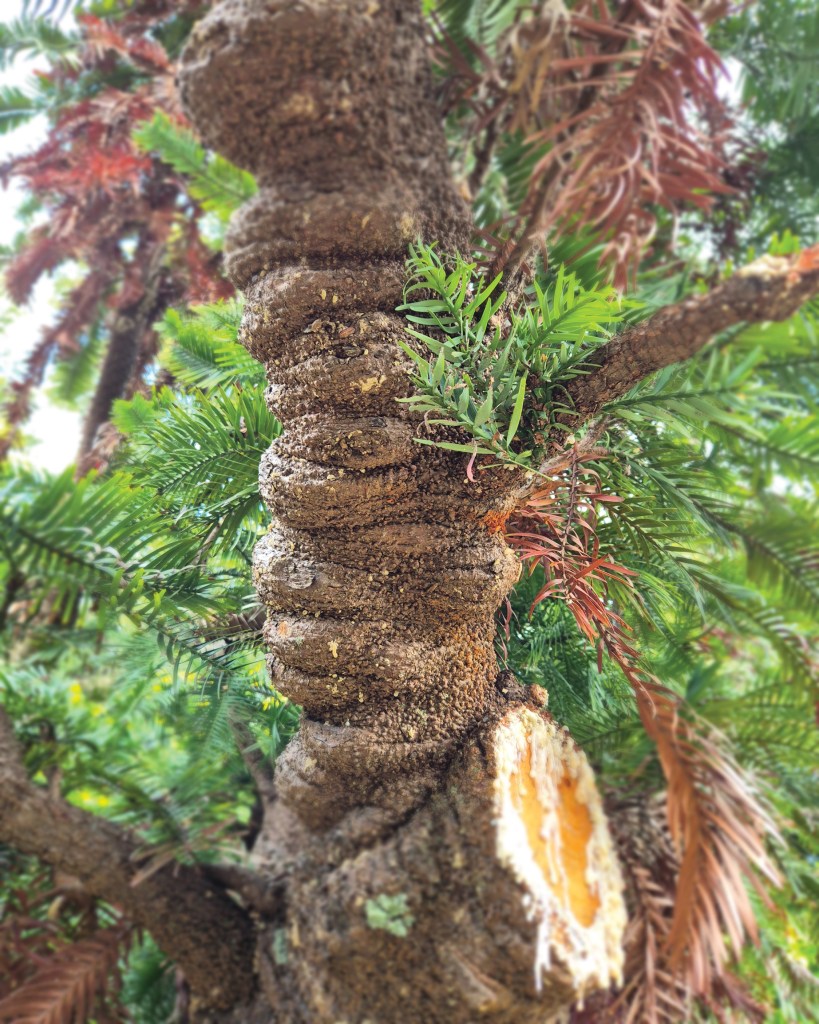
There’s one tree in particular that caught my attention. According to a Google image search, it’s probably a Cocos Palm (Syagrus romanzoffiana), commonly known as a Queen Palm (and, I’m happy to be corrected by any botanists reading this!) But it wasn’t the species that interested me so much as the texture.
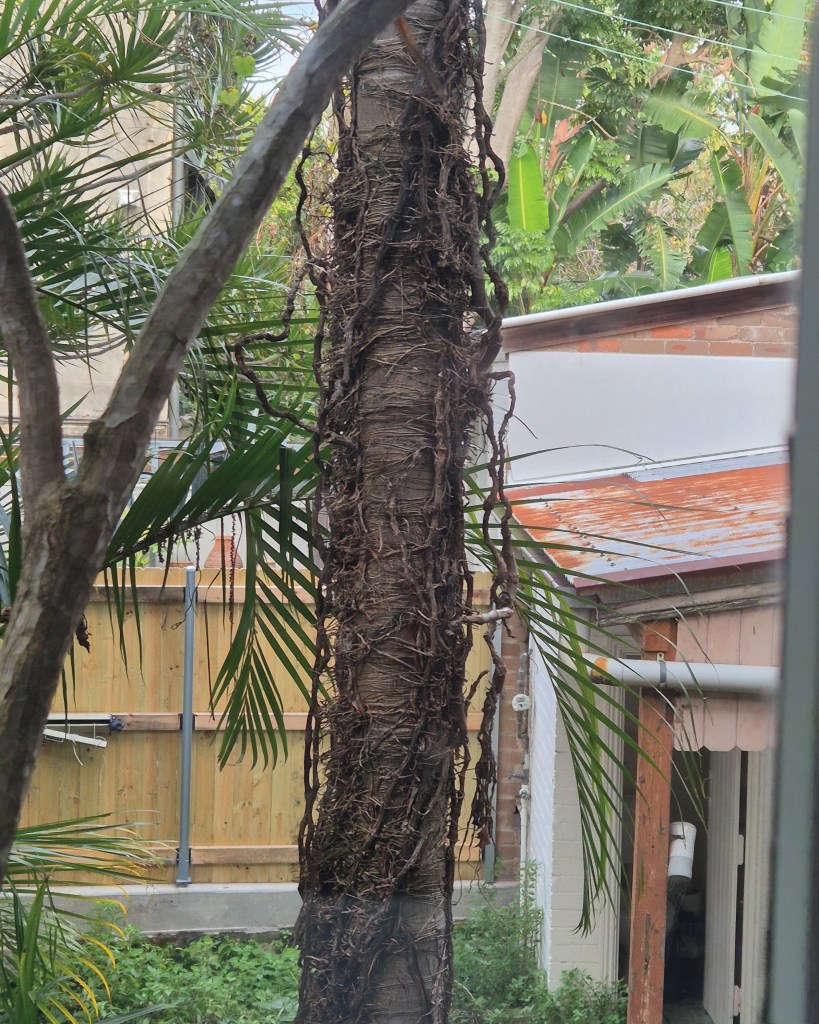
As you can see, the trunk is straight, but in Sydney’s humidity it’s grown masses of aerial roots that twist and cling to the bark. I found myself fascinated by the contrast between the rigid structure of the trunk and the tangled, chaotic roots wrapped around it.
That became the starting point for Day 21.
From Observation to Pattern
My original idea was simple.
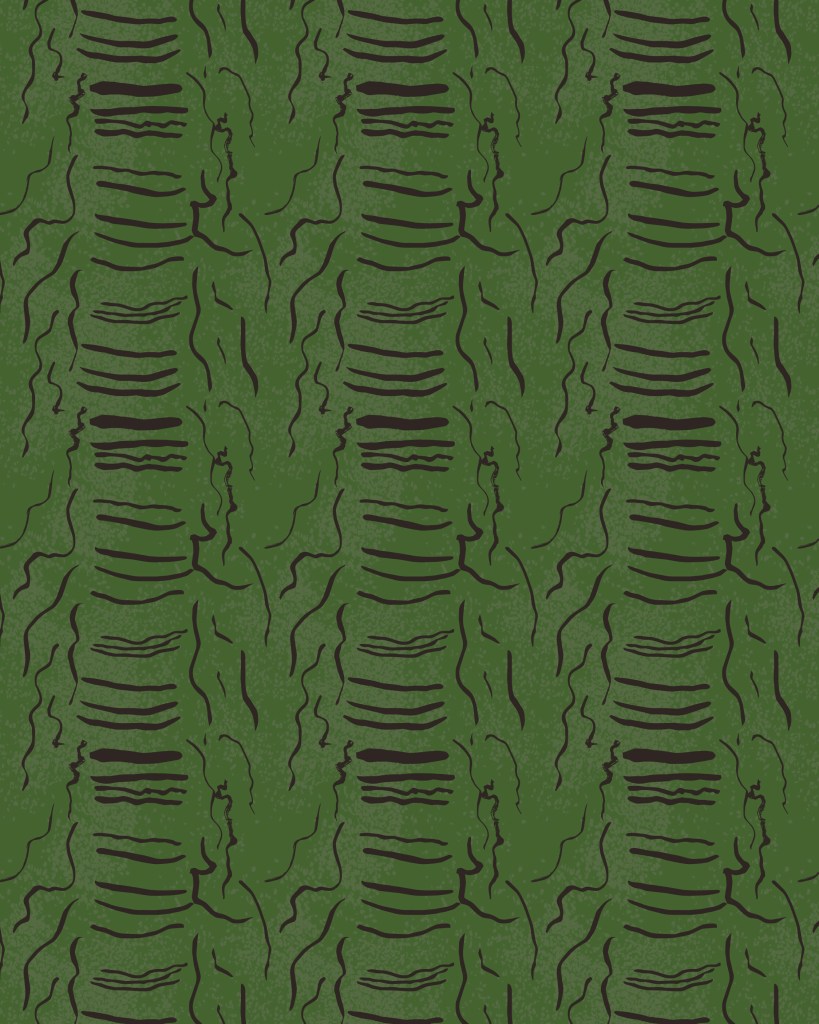
I wanted to use the tree trunk as a stripe and let the roots create a more organic structure between the stripes. The pattern would explore the tension between order and disorder, structure and freedom.
Before opening Illustrator, I spent some time drawing lines with black acrylic ink. Some were smooth and controlled, others wobbled, crooked or unpredictable. In a moment of curiosity, I switched the paint brush to my right hand to see what would happen. It was a genuinely strange experience. Everything became painfully slow, my tongue lodged firmly between my teeth in concentration, and I felt about six years old again learning to write. The resulting marks were awkward and uncertain, but they had a character I couldn’t have created intentionally. I wasn’t trying to draw the tree directly. Instead, I was capturing the feeling of it.
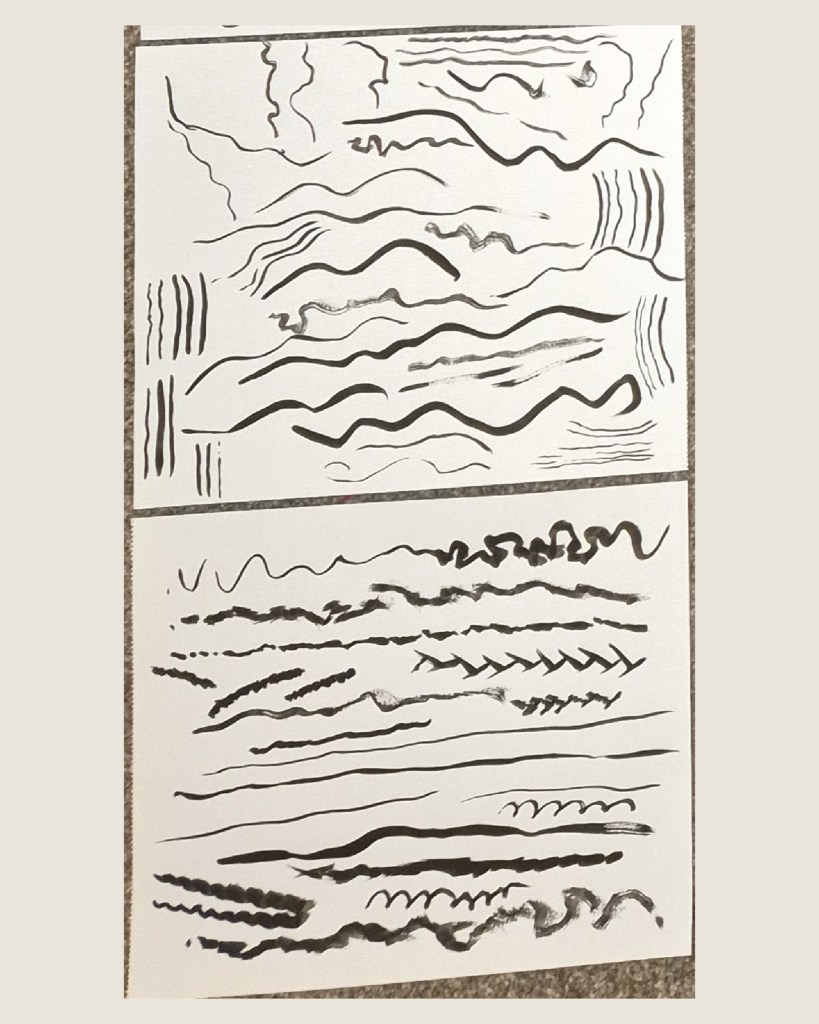
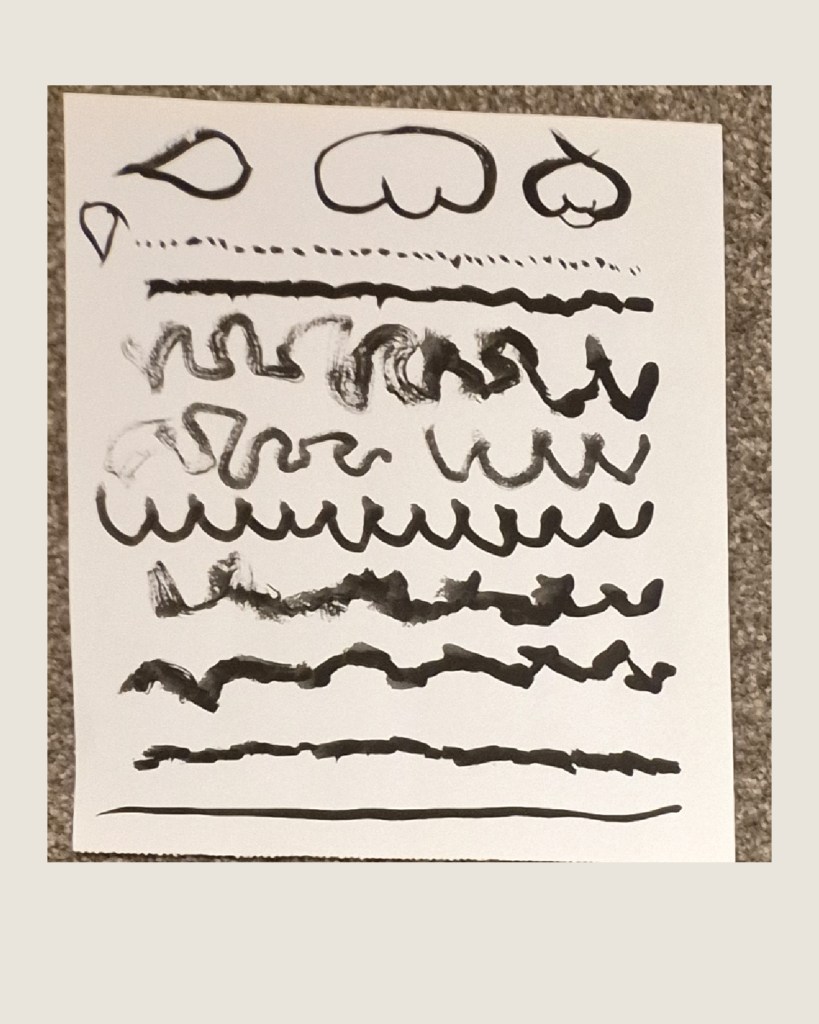
After scanning the marks into Illustrator, I began grouping some of the shorter lines into a central spine and arranging the more irregular lines around them. Because the design consisted of a single repeating stripe, I only needed to repeat it vertically rather than across both directions.
It felt like a fairly straightforward pattern.
Then my imagination took a detour.
A detour through prehistory
When I grow up I want to be a paleontologist.
Ever since I was little, I’ve loved dinosaurs and everything associated with them. Dragonflies and ferns have always fascinated me because they make me think of prehistoric landscapes. Looking at those tangled roots, I started to think about prehistoric forests.
That train of thought led me to one of my favourite trees: the Wollemi Pine.
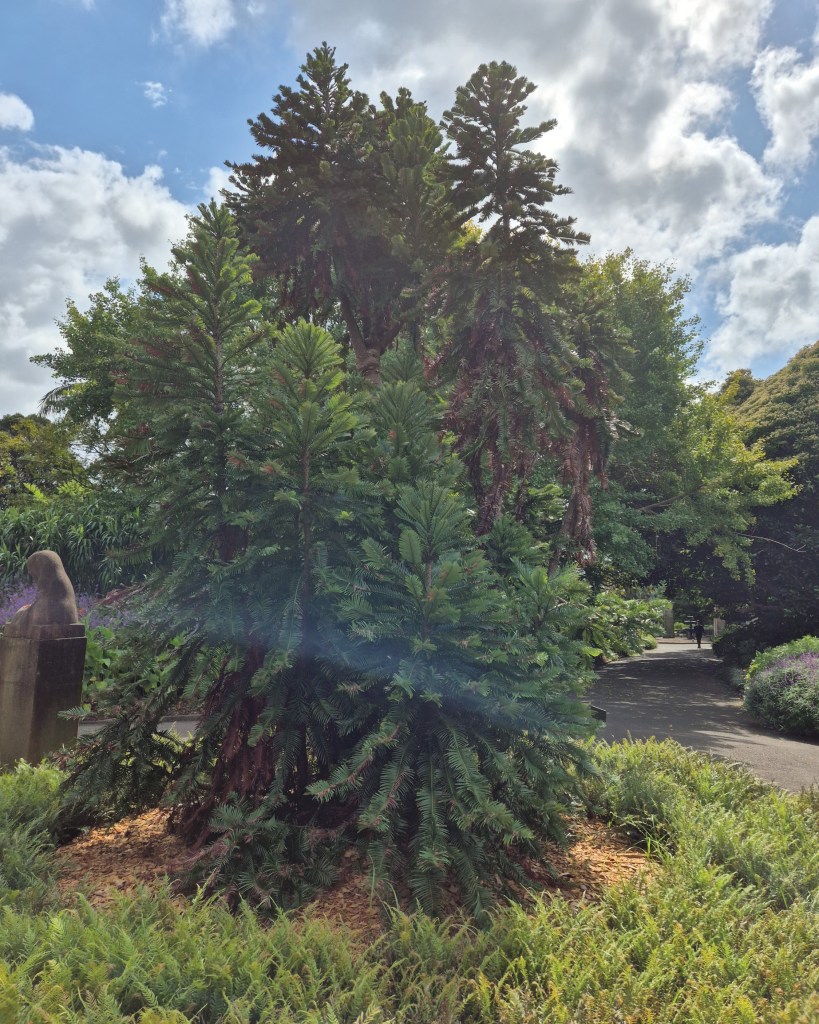
The Wollemi Pine has an extraordinary story. Once thought to be extinct, it was discovered in a remote canyon west of Sydney in 1994. Often described as a “living fossil”, it belongs to a lineage that stretches back to the time of Gondwana and the dinosaurs.
I photographed a Wollemi Pine growing at Sydney’s Royal Botanic Gardens and became fascinated by its distinctive bark. The texture looks almost geological—layered, knobbly and ancient.
It felt like the perfect companion to the prehistoric mood developing in my head.
So I photographed the bark and used that image to create the textured background for the pattern.
The deep greens and dark browns followed naturally.
Before I knew it, what had started as a study of a palm tree outside my window had become a pattern inspired by prehistoric forests and ancient landscapes.
What worked and what didn’t
The finished pattern wasn’t what I expected.
In my mind, the organic elements were always going to be the main event. The roots, the movement and the irregularity were supposed to dominate the design.
Instead, the opposite happened.
The trunk became the focal point and the finer organic elements receded into the background.
Looking at it now, I think a lighter colour and much finer line weight for the trunk would have helped. The organic elements were also difficult to edit in Illustrator without losing their character, so I ended up being more cautious with them than I intended.
The result feels more structured than I imagined.
But that’s also what makes it interesting.
Structure and Freedom
What I find most fascinating about this pattern is that it foreshadowed a lesson that would emerge much more clearly later in the challenge.
I often think about the balance between structure and freedom in my work. At the time, I hadn’t yet articulated it, but the pattern was already exploring that idea.
The trunk became the structure.
The roots became the freedom.
I intended the freedom to dominate, but the structure asserted itself and took centre stage.
There’s probably a metaphor in there somewhere.
Even though the pattern didn’t end up where I expected it to go, I don’t see it as a failure. There’s something worth revisiting. I still like the tension between the rigid and the irregular, and I’d be interested to see what happens if I push that contrast much further.
Next time I’d make the organic elements larger, looser and more dominant. I’d let them spill across the pattern rather than keeping them contained. I’d probably introduce more colour as well—perhaps leaves, flowers or some unexpected bright accents.
Apparently I can only stay away from colour for so long.
If I were using this design in the real world, I suspect it would work best as wallpaper rather than fabric. The scale feels suited to a larger surface where the texture and rhythm have room to breathe.
This pattern didn’t end up where I thought it would.
But it began with a tree outside my window, wandered through a prehistoric forest, borrowed some inspiration from a living fossil, and taught me something about my own creative process along the way.
That’s a pretty good outcome for Day 21.
 Designed by Fi
Leave a comment